
“SEO is no longer about fooling search engines; it’s about serving users and AI in ways they crave truth and utility.” – Rand Fishkin
SEO didn’t suddenly die.
What changed is how answers are chosen.
Search engines are no longer just ranking pages.
They are selecting answers.
This shift is why many technically “well-optimized” pages are losing visibility, while smaller, highly specific pages are getting cited by Google AI Overviews, Perplexity, and other generative search engines.
This is where GEO (Generative Engine Optimization) comes in.
This guide is not theory.
Everything here is tested on funwithai.in, using real queries that now rank at #1 and appear in AI-powered search results.
What Is GEO SEO?
GEO (Generative Engine Optimization) is the practice of structuring content so AI engines can:
- Understand the problem instantly
- Trust the solution
- Reuse the answer verbatim or near-verbatim
Traditional SEO focuses on:
- Keywords
- Backlinks
- Page authority
GEO focuses on:
- Query intent
- Answer completeness
- Proof and execution
- Machine-readable structure
You are no longer optimizing just for ranking.
You are optimizing for selection.
How AI Engines Choose Content Today
When a user searches:
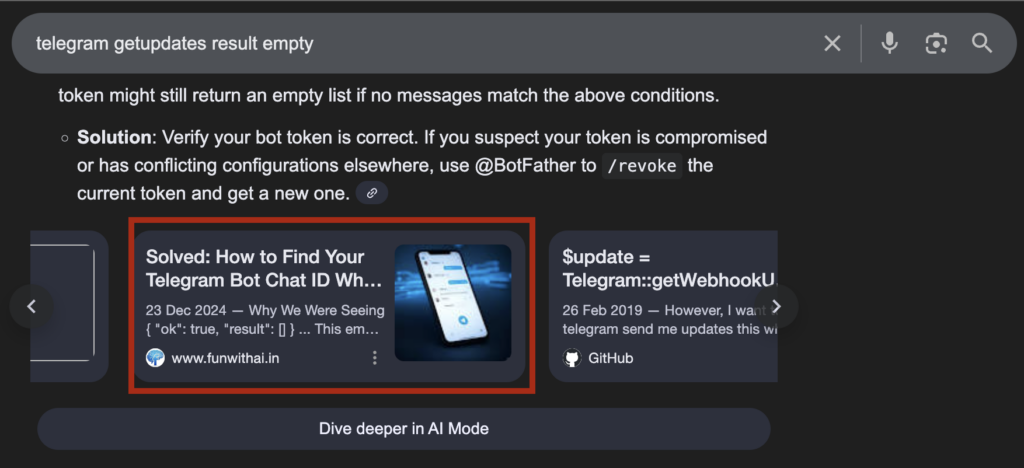
“how to find telegram bot chat id empty response”
AI systems don’t scan for the longest article or the highest DA site.
They look for:
- Pages that describe the exact failure
- Pages that resolve the issue end-to-end
- Pages that provide copy-paste-ready steps
- Pages written in neutral, instructional language
In short:
AI engines prefer finished answers, not explanations.
Why I Used FunWithAI.in as a GEO Testbed
Instead of theory, I tested GEO on my own site.
Why?
- No brand bias
- No massive backlink profile
- Clear cause-and-effect visibility
Tools used:
- Google Search Console (query-level tracking)
- Manual Google searches
- AI Overview observation
- Content rewrites based on query behavior
The result was repeatable wins across unrelated topics.
Case 1: Telegram Bot Chat ID Empty Response
Query:
telegram getupdates result empty
Problem:
Developers call the Telegram getUpdates API and receive:
{"ok":true,"result":[]}
No chat ID. No error. Just silence.
Most articles:
- Explain the API
- Blame Telegram
- Offer vague suggestions
None solve the actual issue.
What the Page Does Differently
The article:
- Names the exact error state
- Explains why the response is empty
- Shows the missing step (user interaction)
- Provides executable commands
Example:
curl "https://api.telegram.org/bot<YOUR_BOT_TOKEN>/getUpdates"
After messaging the bot, the response includes:
"chat": {
  "id": 987654321
}
That is the answer. No ambiguity.
Why AI Engines Prefer This Page
- Exact query match
- Clear failure → fix mapping
- Executable steps
- Verifiable output
This page now ranks #1 and appears in AI-generated answers.
Case 2: WhatsApp Floating Button on WordPress
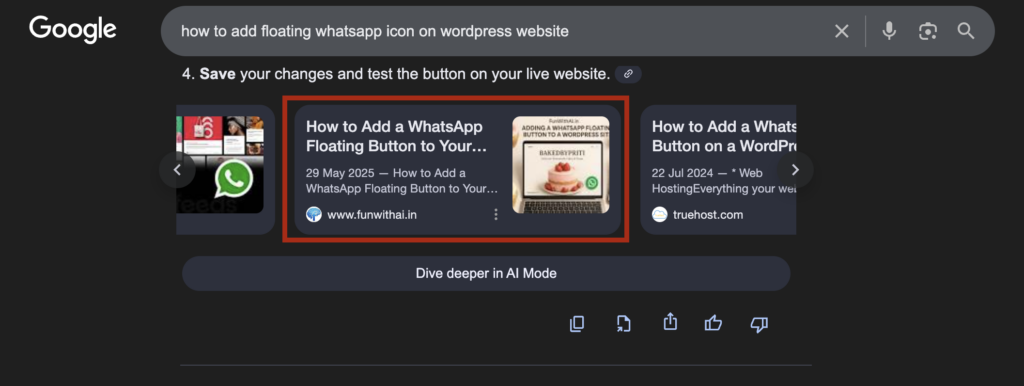
Query:
“how to add floating whatsapp icon wordpress“.
Most results:
- Push plugins
- Add unnecessary bloat
- Skip customization
This article:
- Solves it without plugins
- Uses native WordPress hooks
- Shows the full code
Example:
add_action('wp_footer', 'add_whatsapp_icon');
function add_whatsapp_icon() {
    echo '<a href="https://wa.me/919999999999" class="whatsapp-float">...</a>';
}
Result:
- Lightweight
- Mobile-friendly
- Immediately usable
AI engines favor deterministic instructions like this.
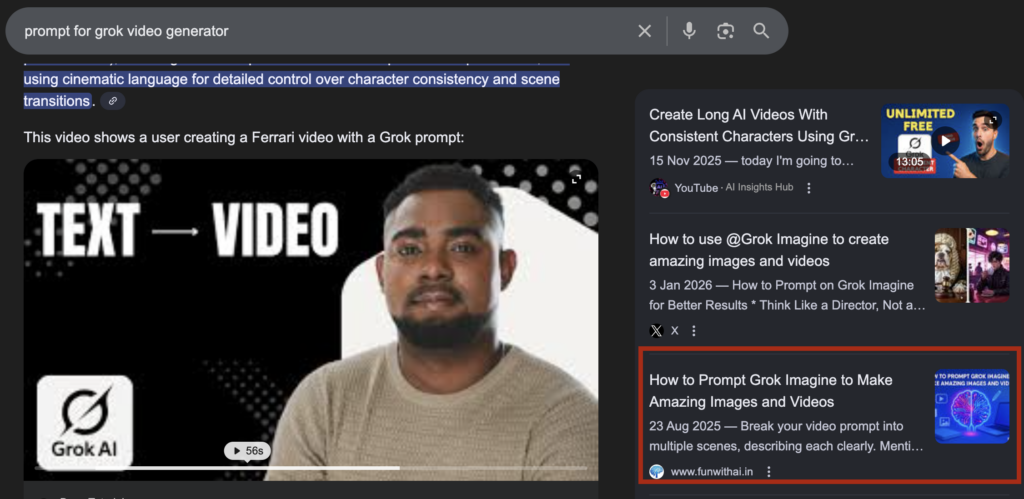
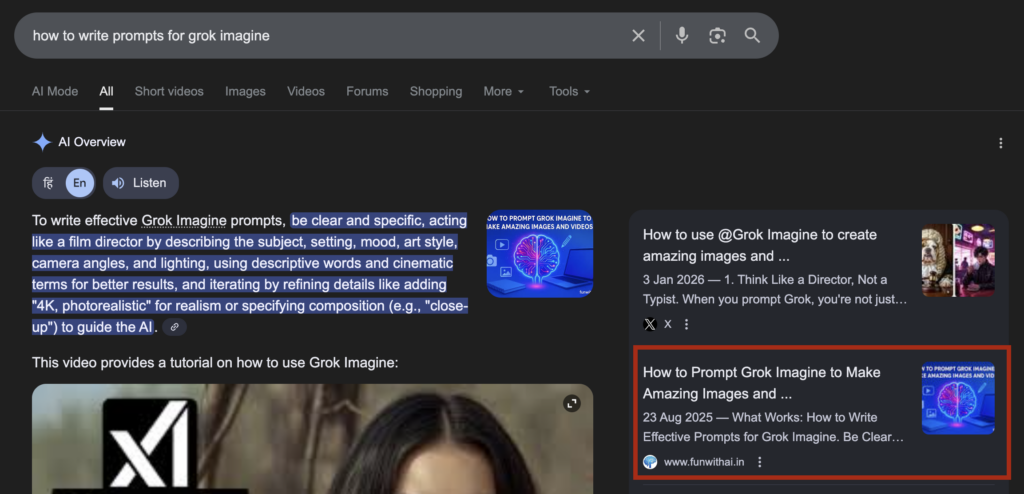
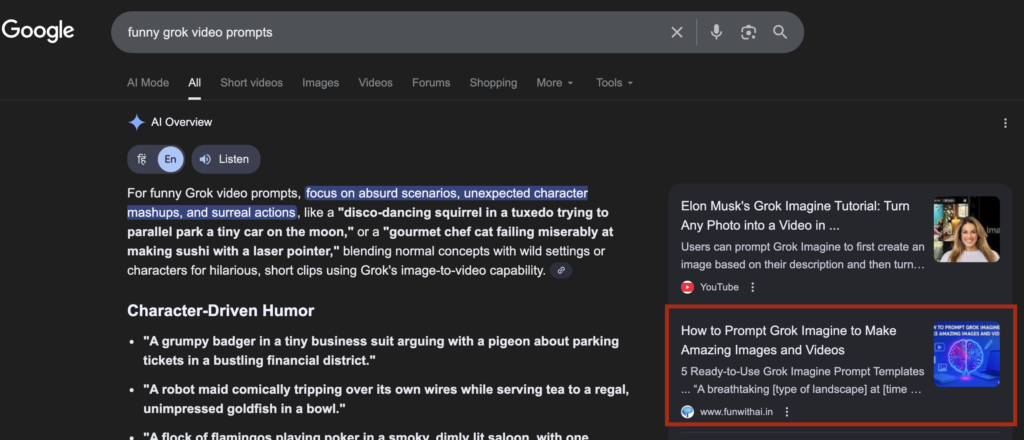
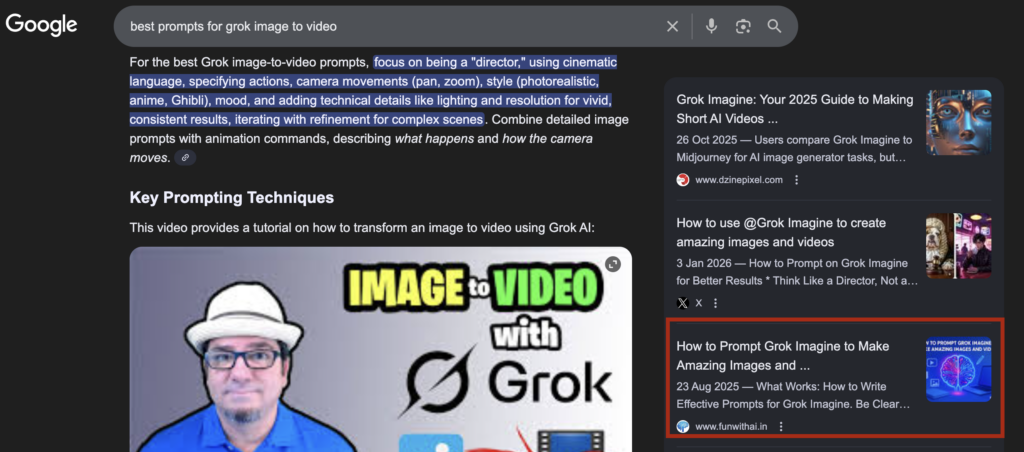
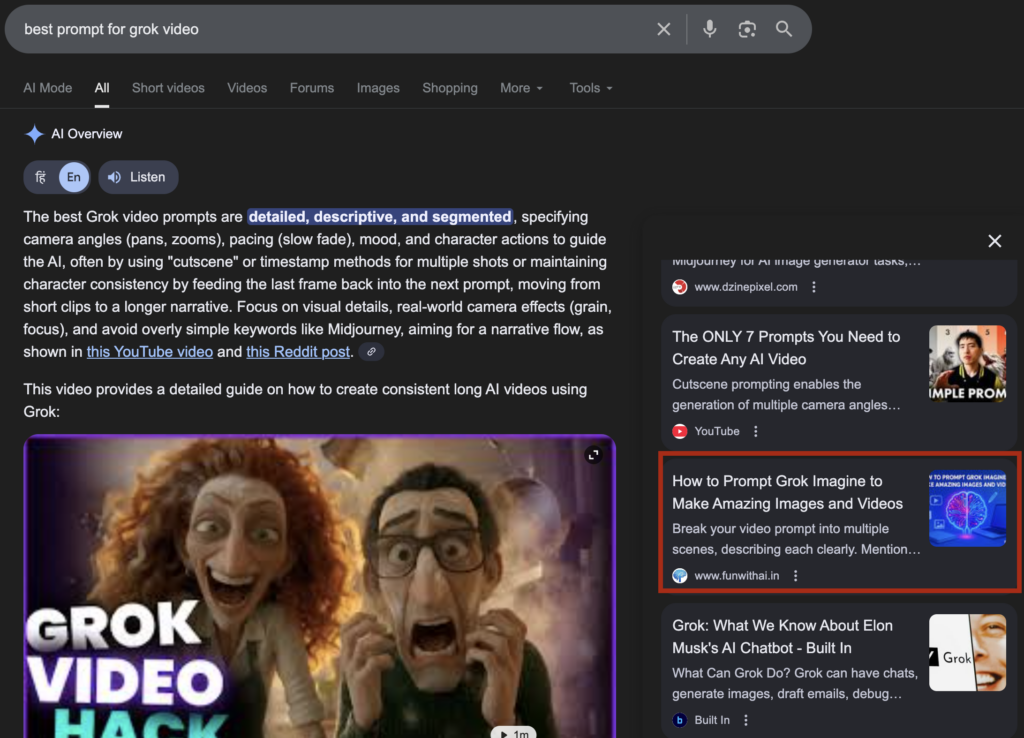
Case 3: Prompting Grok Imagine for Images and Videos
Queries:
- prompt grok imagine video
- best prompts for grok image to video
- funny grok video prompts
These searches are example-driven, not theory-driven.
The article:
- Skips philosophy
- Shows prompt structures
- Includes motion, camera, and style cues
Example prompt:
“A red Ferrari driving along the Monaco coast at sunset, cinematic drone shot, golden hour lighting, ultra-realistic 4K.”
AI engines reuse these prompts because they are:
- Modular
- Clear
- Immediately generative
“prompt for grok video generator”
The 5-Step GEO Framework (Beginner-Friendly)
This is the exact process used across all examples.
1. Start With the Query
Use real, conversational problems.
Not keywords. Queries.
2. Answer Immediately
No storytelling before resolution.
3. Execute Completely
Include:
- Steps
- Code
- Outputs
- Screenshots if possible
4. Prove It Worked
Show:
- Results
- Rankings
- Outputs
5. Structure for Machines
- Headings
- Lists
- Short paragraphs
- Code blocks
- HowTo schema when applicable
Tools Used for GEO (No Fluff)
- Google Search Console
- Query-level impressions
- Click behavior
- Manual SERP Testing
- AI Overview inclusion
- Browser-Based AI Tools
- Perplexity
- Google AI results
No plugins. No hacks.
Common GEO Mistakes
- Long introductions
- Opinion-heavy writing
- No executable steps
- No proof
- Writing for humans only
GEO requires writing for humans and machines simultaneously.
Final Takeaway
GEO is not the future of SEO.
It is the current layer most people are ignoring.
If your content:
- Solves a real problem
- Shows how to fix it
- Proves it worked
- Is cleanly structured
AI engines will find you – even without a big brand.
Conclusion
Follow me on Medium, X, and LinkedIn for more practical guides and deep dives into Python, AI, and SEO. I share fresh tips every week that can save you time and boost your results.
Got questions or ideas? Drop a comment – I love hearing from readers and sharing insights.
And don’t forget to share this post with your network if you think it’ll help them too!
